
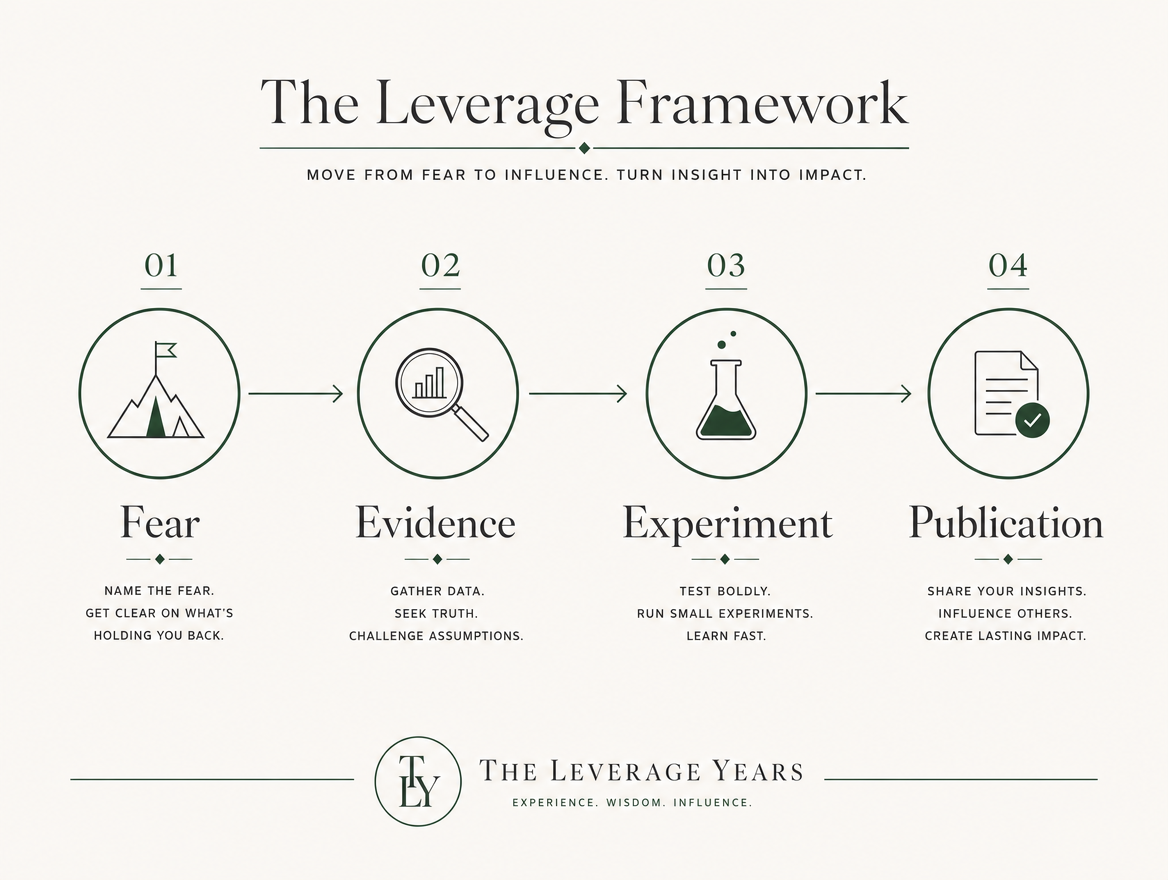
The Content Engine
A content engine is a simple loop: you capture the explanations and arguments you already give in your work, Claude turns them into drafts, and you publish on a schedule without waiting for inspiration. For a professional in your fifties, the win is not "more ideas." You have decades of them. It is finally getting paid, cited, and called for expertise you already earned.
If you have ever opened a blank document on a Sunday, decided you had nothing new to say, and closed it, the problem was never your expertise. You were trying to be creative on demand. Creativity on demand is brutal at any age, and it does not get easier at 55. A system removes the demand. You stop asking "what should I write?" and start running a process that converts the conversations, memos, and arguments you have anyway into authority that compounds.
I resisted this for years because "content engine" sounded like content-mill nonsense. Most of it is. What changed my mind was watching a 58-year-old tax attorney I know go from posting twice a year to twice a week without writing more. She just captured what she was already saying to clients and let Claude clear the drafting bottleneck. That is the model.
What are the three parts of a content engine?
Every system that lasts has the same structure, and skipping one piece is what stalls most people. Capture means grabbing raw thinking the moment it happens, not carving out "writing time" you will never schedule. Draft is the reliable process that turns a fragment into a finished piece, where Claude does the grunt work and you supply the judgment. Repurpose is the rule for getting three or four published assets out of every piece of thinking, because making it once and using it once is the most expensive way to work.
Capture: your best ideas are already leaving the building
The core mistake is treating content as something you invent on a blank page rather than something you record. Your best material shows up unplanned, mid-week, inside real work: the email where you finally explained a messy issue, the objection you handled on a call, the thing in an industry newsletter that made you mildly furious, the question three prospects asked in the same month.
Pick one capture method you will actually use and make it so low-friction it survives bad days. The One-Minute Capture rule is the test: if you cannot record the idea in under 60 seconds, you will not do it consistently. After any call or email where you explained something well, grab the relevant paragraph or talk a voice memo and drop it in one running note with a two-line summary. A working professional generates four or five of these a week without trying. You are not inventing inputs. You are noticing them.
Draft: where Claude earns its keep
This is the friction point that has silenced more experts than any other, which is exactly why it is the part to hand off. Take one captured fragment and give Claude a standing brief: your voice, your audience, your non-negotiables, plus two or three samples of your own past writing so it learns your real register instead of producing the polished beige that screams "written by a machine." Save it as a Project so you brief it once, not every week.
Then the prompt is mundane, which is exactly how you want it: "Here are my rough notes from a client conversation. Draft a 600-word post in my voice that makes one argument, opens with the specific situation, and ends on a concrete takeaway. Keep my phrasing where it is sharp." You get a structured draft in two minutes. Your job is the 20 minutes of editing that make it unmistakably yours: the war story Claude could not know, the strong opinion it would never volunteer, the line only you would write.
Repurpose: one think, four assets
Making something once and publishing it once leaves most of the value on the table. The fix is a fixed rule so you stop deciding each time. The 1-to-4 rule says every substantial post becomes a short version for your network, two or three standalone observations, and one reusable answer you send the next time a prospect asks that question. Claude does the conversion in minutes from the finished piece. You approve, you do not author.
| Stage | You do | Claude does | Time |
|---|---|---|---|
| Capture | Paste the gist of a real conversation | Nothing yet | 1 min, in the moment |
| Draft | Brief once, then edit for voice and judgment | Produces the structured first draft | 20 min |
| Repurpose | Approve and post | Spins 3–4 derivative assets | 10 min |
| The actual insight | This is yours; it is the whole asset | Cannot fake it | Already done |
Why does this work better for experienced professionals?
Because the engine runs on raw material that only experience produces. The same loop in the hands of a 27-year-old generates confident, sourceless takes, the exact stuff serious readers and AI search engines are learning to discount. In your hands it publishes the pattern you have watched play out 40 times, the mistake that cost a client real money, the nuance that only shows up after two decades. Claude can structure that and speed it up. It cannot originate it. Your expertise is the fuel, and it is the part competitors cannot copy or prompt their way to.
That is also why this builds something more durable than reach. Consistent, specific, experience-grounded writing is what gets you quoted, cited, and called, by humans deciding who to hire and increasingly by AI systems deciding whose answer to surface. A pile of bland posts does the opposite. The engine's job is to make your real expertise visible on a schedule, not to manufacture noise.
How often should I actually publish?
Less than the gurus say, more than you do now. Once a week, every week, beats five posts in a burst followed by three silent months. Consistency is the signal that you are a working authority and not a one-time poster. With the engine above, weekly is realistic on roughly an hour of your time, because the thinking is already captured, the drafting is delegated, and the repurposing is mechanical. Pick a day, defend it, and let the system carry the rest.
Will AI-assisted writing hurt my credibility?
Only if you let Claude write instead of using it to draft. The credibility lives in the editing pass, where you add the specific number, the named client situation, the contrarian line. A reader cannot tell whether a sharp, specific, opinionated post started as a voice memo. They can absolutely tell when a generic one was published unedited, because it reads like everyone else's. The engine does not replace your voice. It removes the blank-page tax that has kept your voice off the page.
The move to make this week
Do not design the engine. Start the capture. The next time you explain something well to a client, on a call or in an email, paste those few sentences into a single note before you move on. Do that for one week and you will have four or five real seeds. That note is the engine starting. Everything else, the briefing, the drafting, the repurposing, is just plumbing you bolt on once you have proven to yourself the raw material was there all along.