
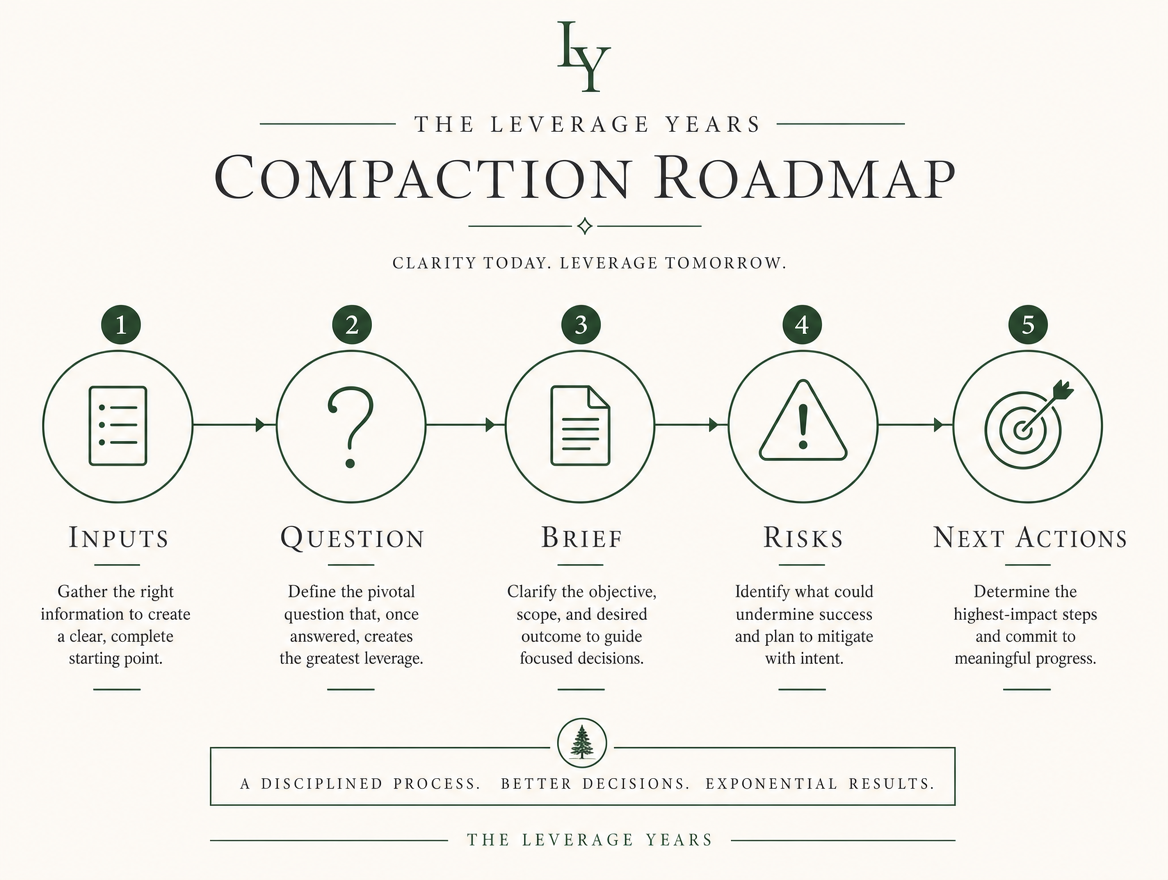
The Four Defended Inputs
By the time you've spent thirty years building judgment, the scarce resource isn't time. It's the four inputs that judgment runs on, and most calendars quietly sell all four for parts.
Your calendar has four inputs worth defending like a balance sheet: deep focus, your best two hours, recovery, and the inputs to your thinking (what you read, who you talk to). Everything else is negotiable. These four aren't. Guard them and your judgment stays sharp into your sixties. Trade them away an hour at a time and you'll stay busy, feel competent, and ship solidly average work, which is the most dangerous place for an experienced operator to live.
I learned this the slow way. For about a decade I assumed a full calendar meant a productive one. It didn't. It meant I was reactive. Reactive people with strong résumés make a particular mistake: they apply twenty or thirty years of judgment to whatever happens to be in front of them, instead of to the few things that actually move the next decade. The calendar was the symptom. The four defended inputs were the cure.
What are the four defended inputs?
They're the raw materials your judgment consumes. When you've been compounding experience for 25 to 35 years, these inputs matter more than raw hours. Lose any one and the quality of your decisions drops before you notice. Here they are, in the order people in their late forties and fifties usually lose them.
1. Deep focus blocks
Two to three hours, uninterrupted, on the work only you can do. Not email triage. Not "catching up." The memo, the model, the negotiation plan: the thing a client or board is actually paying your name for.
After 45, this is where your edge lives: the synthesis that pulls three decades of pattern recognition into a call that looks obvious only after you've made it. It also degrades fastest when fragmented. A three-hour block sliced into six fifteen-minute chunks isn't worth a sixth of a block. It's worth roughly nothing. You keep the fatigue and lose the compounding. A pattern I see constantly: Wednesday has "3 hours for strategy" on it. By Tuesday night it's four "quick" check-ins and a sync that "really needs you there." The day still looks full. The one slot that could've changed next quarter is gone.
2. Your best two hours
Everyone has a window where the mind is naturally sharpest. For most people over 50 it's earlier than they admit, often 7 to 9am, before the inbox loads its first demand. Those two hours are worth three or four of the afternoon kind. The quiet crime is spending them on someone else's priority because that's when the calendar looked "open." Once you're senior, your peak window isn't free capacity. It's already spoken for by the work that compounds: the pricing decision, the term sheet, the hard feedback you've been avoiding. A 52-year-old GC I work with treats 7:30 to 9:30am as "court time": anything that lands there has to matter enough that she'd be willing to explain it to a judge.
3. Recovery
Sleep, a real lunch, a walk without a phone, the five-minute gap between meetings that lets your brain finish a thought. Recovery isn't a reward for finishing the work. It's an input to the work. When it slips, you don't lose energy first. You lose nuance. You default to the easy decision, the familiar pattern, whatever you said last time. The tell isn't yawning. It's irritability with smart people who disagree with you, because your system is too cooked to hold ambiguity. Which is the exact opposite of what a thirty-year career is supposed to buy you: the ability to sit with mess and still make a clean call.
4. Thinking inputs
What you read, who you talk to, what problems you let into your head. A managing partner who lives on client email, Slack, and industry newsletters slowly turns into a slightly worse version of last year's self. The people whose judgment keeps improving in their fifties protect time for the odd book, the long meandering conversation, the problem outside their lane. They stay cross-pollinated, not just updated. This is the input that feels most optional, because nothing breaks when you skip it for a quarter. The cost is invisible for two years and obvious in the third, when you realize you haven't changed your mind about anything important in a long time.
How do you know what deserves a defended slot?
The quick rule: would Future You, ten years older with the same name on the door, recognize why you spent these hours the way you did? Or would it be a blur of "important at the time" items that left no mark? Defended inputs go to work you'd justify in plain language a decade from now: "I spent 90 minutes tightening that pricing model because it changed how we structure deals for the whole portfolio." Un-defended inputs sound like, "It was on my calendar and people would've noticed if I skipped." Forget the mythical perfect week. The goal is narrower: catch the first two or three leaks that turn a strong operator into a harried one.
The "would I defend this in court?" test
This is the rule I use, and it's deliberately a little theatrical. Look at any recurring block and ask: if a judgment-rich version of me had to defend this slot in court, could I, without hand-waving? "It's a standing sync that's mostly status" loses on cross-examination. "It's my 7am focus block on the acquisition memo that decides whether we spend $40M" wins. The test forces you to name what a block actually produces, not what it's called. Most calendars are full of slots named after meetings, not outcomes. Run the test on one week and you'll usually find four to six hours that wouldn't survive a single follow-up question.
Where Claude does the unglamorous defense
The reason these four inputs leak is that defending them is real work: drafting the polite decline, summarizing the meeting you skipped, prepping the agenda so the sync runs 20 minutes instead of 50. That's exactly the work to hand to Claude. Not the judgment. The defense.
A concrete version. Take the standing meeting you'd love to drop but can't quite, because you'd miss something. Forward the notes or transcript to Claude with a standing instruction: "Summarize in five bullets, flag anything that needs my decision, and draft my one-line response to each." Now you reclaim the 50-minute block and keep the five minutes of actual signal. I've watched this one move give a fractional CFO back roughly six hours a week, a full deep-focus day every two weeks, without dropping a single thing that mattered.
The other high-value use is triage of your thinking inputs. Point Claude at a stack of articles, a research report, or that 60-page board deck and ask for the three ideas that would change a decision you're actually facing. You're not outsourcing the reading you love. You're outsourcing the reading you tolerate, so your defended hours go to the reading that sharpens you.
| Input | What it produces | How it leaks | Defense (often with Claude) |
|---|---|---|---|
| Deep focus blocks | The synthesis only you can do | Death by fragmentation | Pre-empt the calendar; Claude handles the prep and follow-up |
| Your best two hours | Your sharpest decisions | Given to others' priorities | Book your peak window first; batch low-stakes work to the trough |
| Recovery | Sustained judgment, not reflex | Treated as a reward, not an input | Schedule it; Claude clears the queue so you can actually step away |
| Thinking inputs | A mind that's still improving | Invisible decline over years | Claude triages the noise; you keep the deep reading |
Is this just time management with a new name?
No, and the difference matters once you're past 45. Time management treats every hour as roughly equal and tries to fit more in. This treats four specific inputs as non-fungible and everything else as fair game to cut, automate, or hand off. You're not trying to be busier, or even, really, to "save time." You're protecting the four things that keep a thirty-year-old judgment from quietly aging into a tired one. The output of a defended week isn't more tasks done. It's better decisions made, by a person who still has the bandwidth to make them.
Start this week with one move: find your single best two-hour window, block it tomorrow before anyone else can, and put the work that scares you a little into it. Then run the court test on next week's recurring meetings and kill or compress the first one that can't defend itself. Four inputs. You don't have to win all four at once, you just have to stop losing the first one by Tuesday.