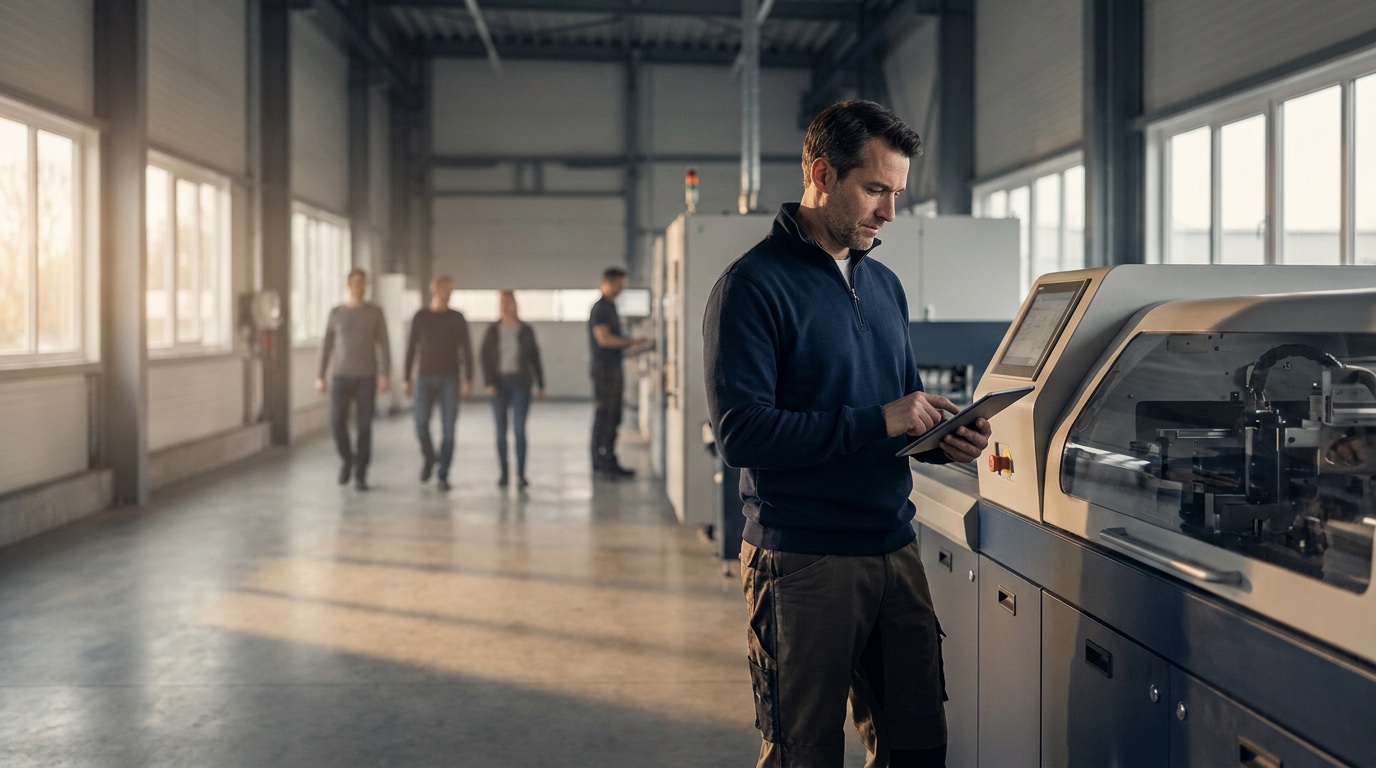
When BMW opened its newest plant in Debrecen, Hungary, the factory had already been running for years — as a simulation. The company planned and optimized the entire facility inside a digital twin before a single physical line was commissioned (BMW Group). Versions of that approach are now live from Bavaria to São Paulo, but the most rigorously documented results are not coming from the marketing-friendly West. They are coming from independently audited plants in India and China.
The popular image of manufacturing AI is a humanoid robot. The real change is quieter: an intelligence layer settling over the existing operation — the data, the documentation, the machines, and the people — making all of them work better.
The short version: Manufacturers run AI across production simulation, predictive maintenance, quality, supply chain, and engineering, and the strongest evidence is independently audited. This briefing leads with the World Economic Forum’s “Lighthouse” plants in India and China, covers Europe’s digital-twin pioneers and the resource industry’s hard numbers, names what is vendor-reported versus verified, and shows where generative AI reaches the operator’s own desk.
The gold standard: WEF Lighthouse plants
The most credible manufacturing-AI numbers carry an independent stamp, because they come from the World Economic Forum’s Global Lighthouse Network, which vets factories before recognizing them. China’s Midea, the appliance maker, runs Lighthouse plants where more than half of its sixty-plus advanced solutions are AI-enabled, and at one site the WEF documented an eighty-five-percent cut in lead time and a forty-two-percent reduction in logistics costs (World Economic Forum). India’s Tata Steel had its Kalinganagar plant recognized as a digital Lighthouse, with McKinsey documenting measurable yield and efficiency gains from AI process optimization across its shop floors (McKinsey). Lenovo’s plant in Monterrey, Mexico, became a second Lighthouse site, applying AI to quality and throughput (Lenovo). These are the figures to trust most, precisely because a third party checked them.
Europe’s digital-twin pioneers
European industry leads on design and simulation. Siemens and BMW, working with NVIDIA, build high-fidelity factory digital twins that let a plant be planned, tested, and reconfigured virtually before anything physical changes (NVIDIA / Siemens). France’s Airbus uses generative design to produce lighter aircraft parts that exceed performance targets, and has partnered with the French AI lab Mistral for secure industrial models — a notable sovereign-AI choice (Airbus). Germany’s Bosch runs deep-learning vision for automated quality inspection across its plants, though the specific downtime and accuracy figures circulating for it come from secondary roundups and should be read with caution (Bosch).
Hard assets, hard numbers
Heavy industry and resources offer some of the most concrete, independently reported gains. In Australia, Rio Tinto’s autonomous drilling delivered a roughly ten-percent productivity improvement, a figure documented in an EY and Minerals Council report rather than a company press release (Minerals Council of Australia / EY). In Brazil, the aerospace manufacturer Embraer uses predictive AI across its supply chain to forecast material shortages and surpluses (NTT Data / Embraer). In Saudi Arabia, Aramco applies generative AI and big-data analytics across its upstream operations, though disclosed metrics there are limited (Saudi Aramco).
Where generative AI reaches the operator’s desk
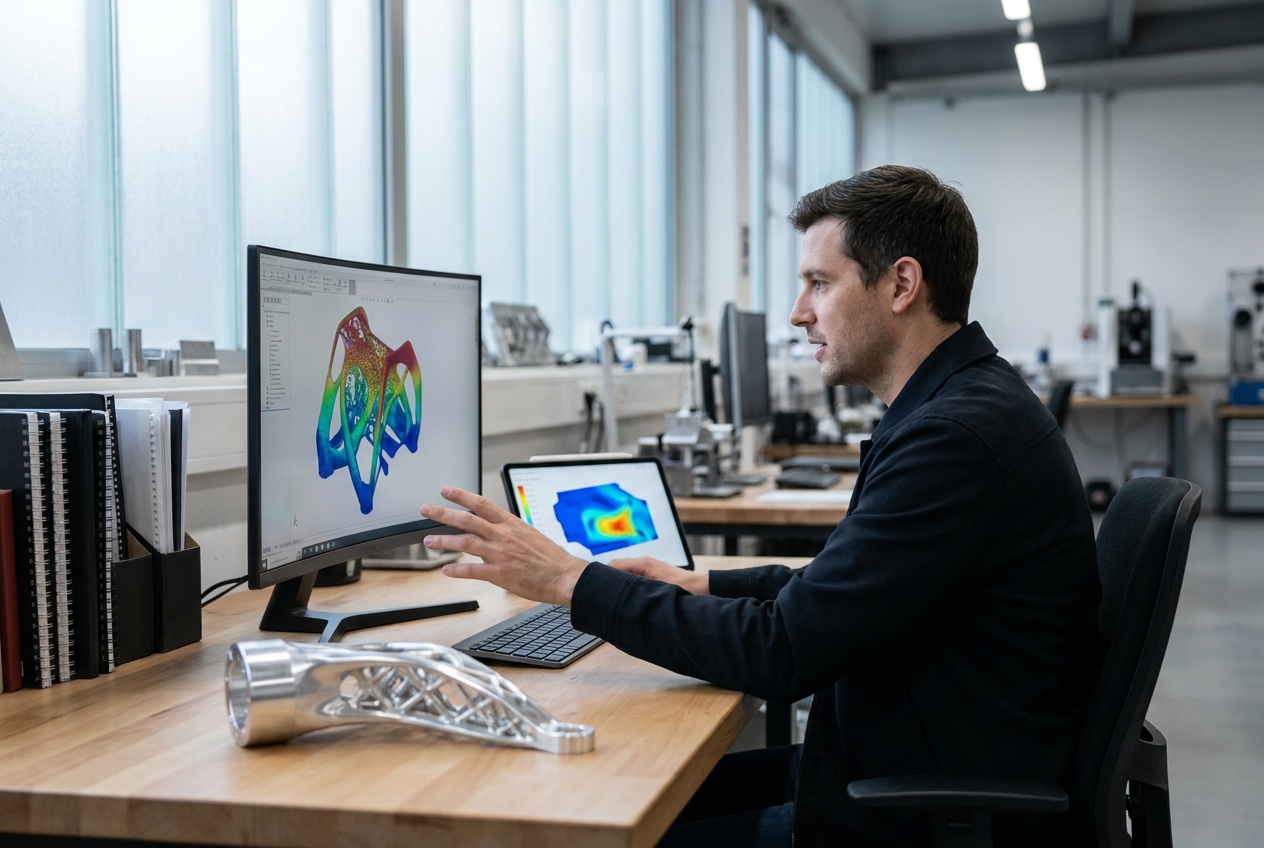
The digital twins and autonomous drills belong to companies with research budgets. The part available to any manufacturer is the generative layer over the plant’s own knowledge: making decades of manuals, fault reports, and shift logs searchable in plain language; turning inspection data into the quality documentation that regulated manufacturers spend enormous time producing; drafting cross-plant reports and standard operating procedures; and preparing a maintenance lead to ask the right question rather than read a dashboard. This is the BMW “Factory Genius” idea — a generative knowledge layer over unstructured factory data — at any scale, and it is exactly the kind of work systems like Claude do well, with a qualified human approving anything that touches safety or output.
How to read the numbers, and the line that stays human
Most industrial-AI figures originate with the company or its technology vendor — the Siemens, BMW, Airbus, and Aramco numbers are vendor-reported and should be read as direction, not audit. The exceptions worth anchoring on are the independently verified ones: the WEF Lighthouse results at Midea and Tata Steel, and the EY-documented Rio Tinto figure. Across all of them, one rule holds: the failure mode in manufacturing is physical, not cosmetic, so any AI output bearing on machine operation, worker safety, or product integrity must pass through a qualified human. The model predicts, drafts, and surfaces; the engineer decides and signs off. That division is what lets a plant move fast without taking on physical risk — the same operating discipline The Leverage Years teaches in every field, with higher stakes.
Frequently asked questions
How are manufacturers using AI?
Across production simulation (BMW and Siemens build factory digital twins with NVIDIA), predictive maintenance, quality inspection (Bosch vision systems), supply-chain forecasting (Embraer), and generative knowledge work over plant documentation. The most independently credible results are WEF-audited Lighthouse plants: Midea (China) cut lead time 85% and logistics cost 42%, and Tata Steel (India) recorded McKinsey-documented efficiency gains. Rio Tinto (Australia) reported a ~10% drilling-productivity gain in an EY report.
Which manufacturing AI results are most trustworthy?
The independently audited ones: the WEF Global Lighthouse Network plants (Midea, Tata Steel, Lenovo) and EY-documented figures like Rio Tinto's. Most other industrial-AI numbers — from Siemens, BMW, Airbus, and Aramco — are reported by the company or its technology vendor and should be treated as directional rather than audited.
What is the best first AI project for a manufacturer?
The knowledge layer. Making decades of manuals, fault reports, SOPs, and shift logs searchable in plain language is low-risk and high-value, captures expertise at risk of retiring out the door, and requires no change to the production line. It is the BMW “Factory Genius” idea at any scale, and the safest place to learn the operating discipline before automating anything physical.
Is AI safe to use on the factory floor?
It is safe when a qualified human controls anything affecting machine operation, worker safety, or product integrity. The failure mode is physical, so responsible programs use AI to diagnose, draft, and surface while a trained person approves every consequential action. Over-automating before a system has earned trust is the main risk, avoided by keeping tight constraints and human oversight on the loop.